
Imagine getting hit by a ransomware attack at 3:00 AM on a Sunday. For a US-based mid-market business, this isn’t just an IT nightmare—it’s a compliance liability that could cost hundreds of thousands of dollars. You know you need a 24/7 Security Operations Center (SOC) to keep your infrastructure safe and satisfy your cyber insurance mandates.
But then you look at the price tag.
Enterprise-grade Commercial SIEM licenses can easily drain your annual IT budget, while hiring a dedicated team of US-based tier-1 SOC analysts can cost upwards of $90,000 per engineer. Suddenly, building a defensive shield feels financially impossible.
This brings IT directors and infrastructure managers to a critical crossroads: Should you build a budget-friendly SOC using Open-Source SIEM tools, or bite the bullet and invest in a Cloud-Native Commercial solution?
In this guide, we will break down the true Total Cost of Ownership (TCO), compliance readiness, and operational reality of both paths so you can make an authentic, board-approved decision for your infrastructure.
The Open-Source Route: Maximum Control, Zero License Fees
When visibility is the goal but software budget is flat zero, open-source SIEM and security monitoring platforms like Wazuh or the ELK Stack (Elasticsearch, Logstash, Kibana) look incredibly attractive.
For a lean IT department, deploying an open-source platform feels like a massive win. You download the ISO or deploy the Docker containers, spin up the manager, and suddenly you have a centralized dashboard collecting logs without paying a single dollar to a software vendor.
The Heavy Hitters: Wazuh vs. ELK
Wazuh: Built specifically for security. It combines endpoint monitoring (EDR/XDR features) with log analysis out of the box. It gives you immediate compliance mapping for PCI-DSS, GDPR, and NIST.
ELK Stack: A broader data analytics engine. While powerful, it requires significant manual configuration (Logstash filters, custom parsing rules) before it behaves like a true security tool.
The Hidden Cost Analysis for Businesses
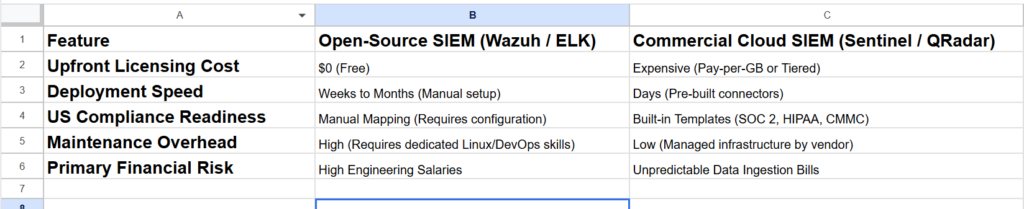
While the software is free, open-source is never truly “free.” In the US market, the financial shift happens from OpEx (Software Capital) to Human Capital (Salaries).
- The Engineering Overhead: Open-source SIEMs are complex beasts. Parsing custom syslog data from a FortiGate firewall or a SonicWall appliance requires deep engineering expertise. If a parsing rule breaks after a firewall firmware update, your team has to fix it manually.
- The Infrastructure Cost: Storing terabytes of hot and cold logs for compliance (like keeping data for 1 year under SOC 2 requirements) means you have to pay for substantial AWS/Azure cloud storage or heavy on-prem server hardware.
- The “Bus Factor”: If you hire one brilliant engineer who builds your entire custom Wazuh infrastructure and they leave for a higher-paying US tech job, your SOC security configuration walks out the door with them.
The Verdict on Open Source: If you already have a highly skilled, internal system engineering team that can dedicate hours to maintaining configuration files and managing index lifecycles, Open Source is a goldmine. If not, you are just trading a software bill for a massive engineering workload.
The Commercial Route: Out-of-the-Box Power at a Premium Price
If Open Source is a DIY project, Commercial SIEM solutions like Microsoft Sentinel or IBM QRadar are the turnkey luxury apartments of the cybersecurity world. You pay a premium, but you get immediate operational readiness.
For US mid-market businesses struggling with immediate compliance deadlines or tight cyber insurance renewals, commercial cloud-native platforms are often the default choice.
The Heavy Hitters: Cloud-Native vs. Traditional Enterprise
- Microsoft Sentinel: A cloud-native SIEM/SOAR platform. If your US client is already running their infrastructure on Microsoft 365 and Azure, Sentinel is incredibly easy to deploy. It features “one-click data connectors” that ingest Office 365 audit logs for free, which is a massive selling point for IT directors.
- IBM QRadar: A heavyweight in the enterprise world. Known for its advanced Network Behavior Analytics and powerful AQL (Ariel Query Language) engine. It is incredibly robust but usually requires dedicated, certified experts to manage and can feel overly heavy for a mid-market setup.
The True Cost Reality: The Ingestion Trap
While commercial tools save you from manual configuration nightmares, they introduce a different kind of stress: Predictability of Cost.
- The Per-GB Pricing Model: Cloud-native SIEMs like Microsoft Sentinel charge based on the volume of data you ingest (per gigabyte). If a Windows server or a core network switch suddenly goes into a verbose logging loop due to a misconfiguration, your monthly cloud bill can skyrocket unexpectedly.
- The Retention Bill: Cyber insurance mandates and regulations like HIPAA require businesses to store logs for months or even years. In commercial cloud platforms, keeping archive data (“cold storage”) active can quietly accumulate thousands of dollars on the monthly invoice.
The Verdict on Commercial: Commercial SIEMs are built for speed and compliance compliance. You don’t need a 5-man engineering team just to maintain the tool; you just need analysts to watch the alerts. However, you must carefully filter your logs at the source (e.g., at the firewall level) to avoid paying for junk data ingestion.
Side-by-Side Comparison: Making the Boardroom Choice
When presenting to US stakeholders or a CFO, numbers and clear structural differences matter more than technical jargon. Here is how the two paths stack up for a mid-market infrastructure:
The Financial Verdict: Which One Should You Choose?
So, how do you decide without draining your budget? The answer depends entirely on your existing internal resources in the US market:
- Choose Open Source (Wazuh) if: You already have an internal team of system administrators or Linux engineers who can absorb the maintenance workload, and your log volume is massive (e.g., high-throughput network firewalls) where commercial ingestion costs would be financially ruinous.
- Choose Commercial (Sentinel) if: Your internal IT team is small (1-2 people), you are deeply integrated into the Microsoft ecosystem, and you need to pass a SOC 2 or HIPAA audit within the next 30 days to close US enterprise clients.
Ultimately, a budget-friendly SOC isn’t just about the cheapest software—it’s about choosing the model that keeps your infrastructure secure without creating hidden operational debt.