
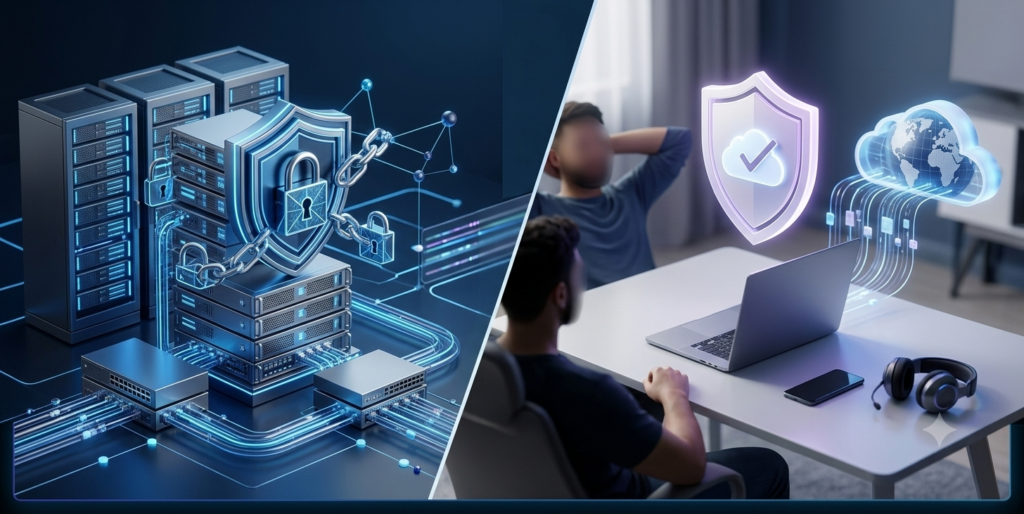
In today’s distributed work environment, securing enterprise IT infrastructure is no longer just a checkbox for compliance—it is a matter of business survival. With cloud deployments scaling rapidly and remote work becoming the corporate standard, the traditional perimeter of the office network has dissolved.
To safeguard sensitive data, many small-to-medium businesses (SMBs) turn to Virtual Private Networks (VPNs). However, a costly and common mistake many IT managers and business owners make is deploying standard, off-the-shelf consumer VPNs to protect corporate assets.
While a consumer VPN is excellent for an individual looking to mask their IP address or bypass geo-restrictions on a business trip, it fundamentally lacks the architecture required to protect an enterprise ecosystem. Network security, access control, and infrastructure compliance require something far more robust.
If your team is accessing AWS buckets, private Git repositories, local NAS drives, or internal ERP software, relying on a personal VPN leaves massive gaps in your security posture.
In this comprehensive evaluation, we will break down the structural differences between Business VPNs vs. Consumer VPNs, analyze why consumer solutions fall short in enterprise environments, and explain how dedicated business solutions protect your infrastructure from costly data breaches.
Quick Comparison: At a Glance
| Feature | Consumer VPN | Business VPN |
|---|---|---|
| Primary Objective | Individual anonymity & privacy online. | Securing access to internal corporate networks. |
| IP Architecture | Shared, dynamic IPs (Changes on every connection). | Dedicated, static IPs (Fixed for your organization). |
| Access Control | No centralized control; every user acts independently. | Centralized Admin Dashboard to provision/revoke access. |
| Network Security | Connects users to public internet servers. | Supports Site-to-Site tunnels and Zero Trust (ZTNA). |
| Compliance & Logs | Strictly "No-Logs" policy (No audit trail for IT). | Detailed activity logs for HIPAA, PCI-DSS compliance. |
| Customer Support | Standard ticket/chat support. | 24/7 dedicated account manager & priority SLAs. |
Understanding Consumer VPNs (And Where They Fail Corporate Infrastructure)
To understand why your infrastructure needs a dedicated solution, we must first look at the design architecture of consumer VPNs. Top-tier consumer VPNs—such as NordVPN or ExpressVPN—are engineered with a single goal in mind: individual user privacy.
When a user connects to a consumer VPN, their traffic is encrypted and routed through a massive pool of public servers scattered across the globe. This masks the user’s actual IP address and replaces it with a shared, dynamic IP.
While this architecture is perfect for safeguarding a remote employee working from a local coffee shop or bypassing geo-restrictions, it introduces critical vulnerabilities when applied to an enterprise network:
- The Shared IP Security Nightmare: Consumer VPNs route thousands of unrelated users through the same server. If an unknown user on that same IP engages in malicious activity, that IP can get blacklisted. More importantly, you cannot use a shared, rotating IP to configure firewalls or secure internal resources.
- Total Lack of Centralized Control: In a consumer setup, every employee owns and manages their own individual account. If a network administrator needs to immediately revoke access for a terminated employee or a compromised device, they cannot do it. There is no central dashboard for the IT team to manage credentials.
- The “No-Logs” Blindspot: Consumer VPNs pride themselves on strict “No-Logs” policies. For personal privacy, this is fantastic. For an IT infrastructure manager, this is a compliance disaster. If a data breach occurs, your security team will have zero logs, zero audit trails, and no visibility into who accessed what resource.
Enter the Business VPN: Engineered for Network Infrastructure
Unlike its consumer counterpart, a Business VPN (often evolving into modern ZTNA – Zero Trust Network Access solutions like NordLayer or Perimeter 81) is built specifically to connect remote users directly and securely to your private corporate ecosystem.
Instead of throwing your employees onto the public internet via a shared server, a business VPN establishes a private, encrypted gateway dedicated solely to your company. This fundamental shift in architecture introduces enterprise-grade capabilities:
- Dedicated Static IPs for Whitelisting: Your organization is assigned a fixed, clean IP address. This allows your IT administrator to configure strict firewall rules on your cloud environments (like AWS, Azure, or Google Cloud) and on-premise hardware. You can essentially tell your servers: “Only allow incoming traffic if it originates from our company’s dedicated VPN IP.”
- Centralized Identity & Access Management (IAM): Business VPNs feature a centralized administrative control panel. Administrators can provision new user profiles, enforce Multi-Factor Authentication (MFA), group employees by department (e.g., giving the DevOps team access to staging servers while blocking the HR team), and instantly revoke access tokens with a single click.
- Compliance-Ready Audit Logs: Business VPNs provide comprehensive access logs. Your security operations center (SOC) can track exact connection times, active user sessions, and resource utilization. This data is critical for fulfilling regulatory compliance frameworks such as HIPAA, PCI-DSS, and SOC 2 in the US market.
4 Reasons Your IT Infrastructure Cannot Survive on a Consumer VPN
If you are currently running your startup, agency, or enterprise cloud environment using consumer-grade privacy tools, you are maintaining a massive security gap. Here is why modern IT infrastructure demands a dedicated business solution:
- Granular Access Control (Network Segmentation)
In a standard VPN setup, once a user connects, they often get broad access to the entire network. A Business VPN allows for micro-segmentation. Your IT administrator can create strict access policies: the development team gets access to AWS staging environments, the accounting team gets access to the payroll servers, and marketing is kept completely separate. This ensures that even if one employee’s device is compromised, the hacker cannot move laterally across your entire infrastructure.
- IP Whitelisting for Cloud and On-Premise Assets
Securing your databases and cloud dashboards (like Jenkins, Jira, or custom ERPs) by leaving them open to the public internet with just a password is a recipe for a brute-force disaster. With a Business VPN, you get a Dedicated Static IP. You can configure your firewalls to drop all traffic unless it originates from that specific corporate IP. This effectively hides your critical infrastructure from the public internet.
- Seamless Site-to-Site Connectivity
If your business operates with multiple physical locations—such as a headquarters in New York, a branch office in Austin, and a local data center—you need them to communicate securely. Business VPNs support Site-to-Site tunneling, meaning your hardware firewalls at different locations can maintain a continuous, encrypted connection, merging them into a single secure corporate network.
- Mitigating the Insider Threat with Zero Trust (ZTNA)
Modern business VPN platforms are transitioning into Zero Trust Network Access (ZTNA) solutions. The core philosophy is simple: Never Trust, Always Verify. Even if an employee is connected to the VPN, the system continuously verifies their device compliance, location, and identity before granting access to specific infrastructure assets.
Top Enterprise Business VPN Solutions to Evaluate in 2026
Now that you understand the architectural necessity of a dedicated solution, which platform should you deploy for your infrastructure? Here is our expert evaluation of the market leaders:
1.NordLayer (Best for SMBs and Rapid Deployment)
Created by the security veterans behind NordVPN, NordLayer is an enterprise-grade solution designed specifically for smooth integration into existing corporate infrastructure.
- Key Features: Easy-to-use centralized control panel, seamless single sign-on (SSO) integration with Google Workspace and Azure AD, and hardware-free deployment.
Best For: Growing teams and IT managers who want corporate-level security without dealing with complex command-line configurations.
2.Perimeter 81 (Best for Complex Cloud & Zero Trust Infrastructure)
Now backed by Check Point’s enterprise security ecosystem, Perimeter 81 is a heavyweight in the network-as-a-service (NaaS) space.
Key Features: Advanced Software-Defined Perimeter (SDP), built-in cloud firewall capabilities, and deep monitoring analytics for security operations centers (SOCs).
Best For: Highly technical environments, DevOps teams, and companies managing hybrid cloud infrastructure across multiple providers.
3.Tailscale (Best for Developers and Internal Infrastructure Mesh)
If your infrastructure is highly decentralized and managed by engineering teams, Tailscale offers a radically modern approach based on the WireGuard® protocol.
Key Features: Zero-config mesh VPN architecture, peer-to-peer secure connections that bypass centralized servers, and deep integration with Linux/Docker environments.
Best For: IT infrastructure professionals, SysAdmins, and development teams who prioritize raw performance and open-source protocol reliability.
Conclusion: Making the Right Call for Your Enterprise Security
When evaluating Business VPNs vs. Consumer VPNs, the choice ultimately comes down to your operational goals. If your primary objective is personal anonymity, unblocking regional content, or securing a single device on public Wi-Fi, a premium consumer VPN is a highly effective tool.
However, if you are responsible for managing, scaling, or securing corporate IT infrastructure, a consumer VPN is a liability.
To protect proprietary data, meet stringent industry compliance standards, and maintain strict access control over your servers, you need a dedicated business architecture. Investing in a solution like NordLayer or Perimeter 81 provides the centralized management, static dedicated IPs, and Zero Trust security framework required to shield your network from evolving cyber threats.
Don’t wait for a data breach or a compromised credential to expose your internal network. Secure your infrastructure today by transitioning to a dedicated corporate network security platform.