Discover the 5 critical stages of ethical hacking and penetration testing. Learn how white hat hacking protects enterprise systems from modern cyber threats.
What is Ethical Hacking & Penetration Testing?
In today’s interconnected digital landscape, proactive cybersecurity is critical for safeguarding enterprise infrastructure. Ethical hacking—commonly referred to as white hat hacking or penetration testing—is the authorized practice of evaluating the security of computer systems, networks, and web applications. By simulating real-world cyberattacks, white hat hackers systematically identify vulnerabilities before malicious threat actors can exploit them. To execute a comprehensive assessment, security professionals follow a structured 5 stages of ethical hacking methodology.
Five Stages of Ethical Hacking
This introductory slide sets the core focus of the guide. Ethical hacking is not a series of random attempts; it is a structured, systematic process used by cybersecurity professionals to evaluate, test, and harden enterprise infrastructure against sophisticated digital threats.
Code of Conduct & Ethics
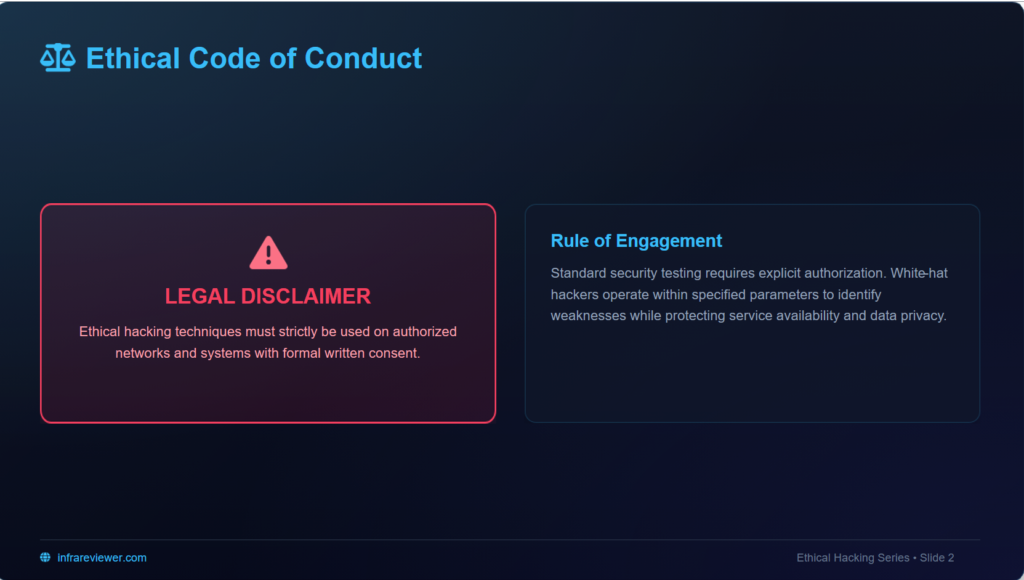
Authorized penetration testing strictly requires explicit written permission and a defined scope of engagement from system owners, ensuring all security assessments remain legal and controlled.
Overview of the 5 Stages
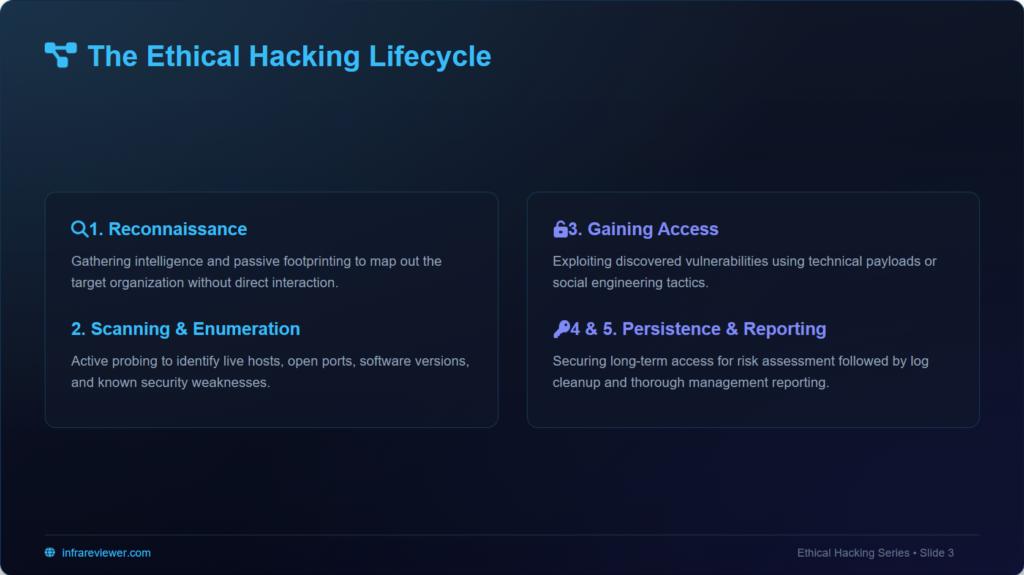
Here is a high-level overview of the complete penetration testing lifecycle: Reconnaissance, Scanning & Enumeration, Gaining Access, Maintaining Access, and Covering Tracks & Reporting. Each phase plays a vital role in mapping system vulnerabilities.
Stage 1 – Passive Reconnaissance
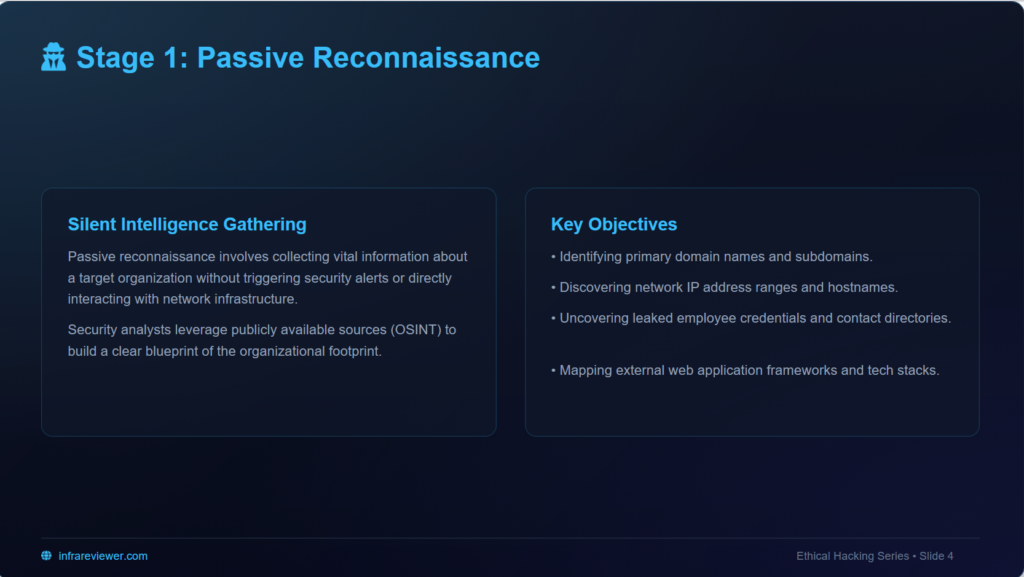
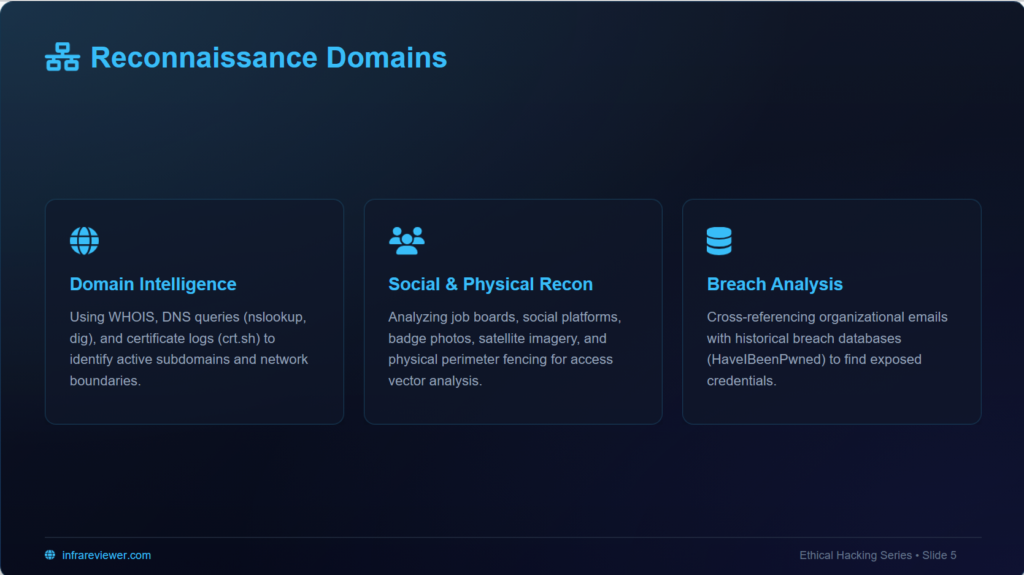
The first stage centers on passive information gathering (OSINT). During passive recon, ethical hackers collect publicly available domain, email, and network data about the target organization without directly interacting with internal servers or alerting security systems.
Physical & Social Reconnaissance
Beyond digital assets, passive reconnaissance evaluates physical and human security posture. Security analysts examine satellite imagery, facility access points, organizational structures, employee job titles, and publicly shared office details to identify potential social engineering targets.
Web & Host Reconnaissance
This section focuses on technical passive reconnaissance methods. It includes verifying domain ownership via WHOIS, discovering subdomains, identifying underlying web technology stacks (fingerprinting), and cross-referencing exposure records across historical data breach sets.
Stage 2 – Scanning & Enumeration
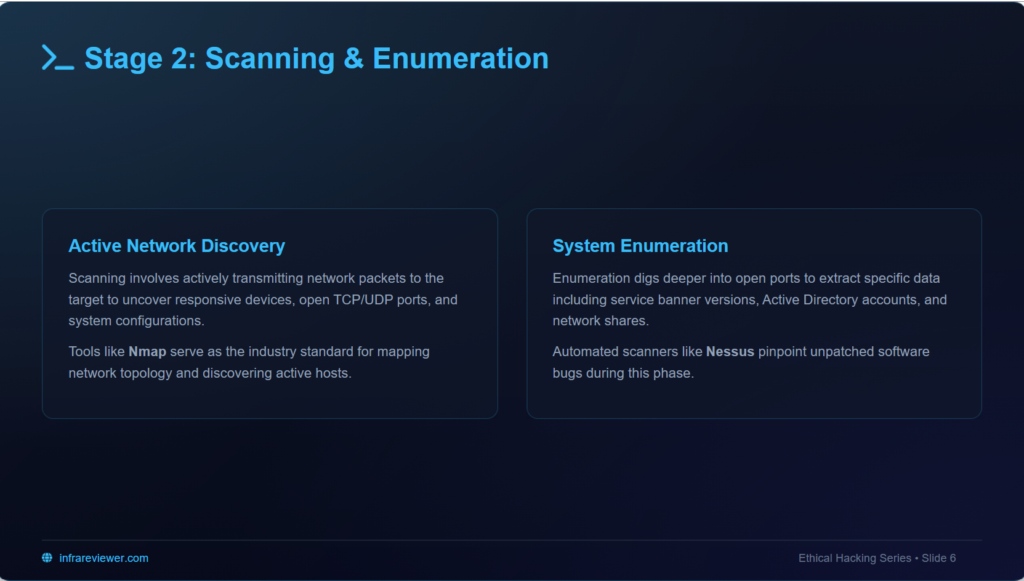
Stage 2 transitions into active engagement. Ethical hackers send active network probes to target IP ranges to identify live hosts, open network ports, active services, and unpatched software vulnerabilities using industry tools like Nmap and Nessus.
Stage 3 – Gaining Access (Exploitation)
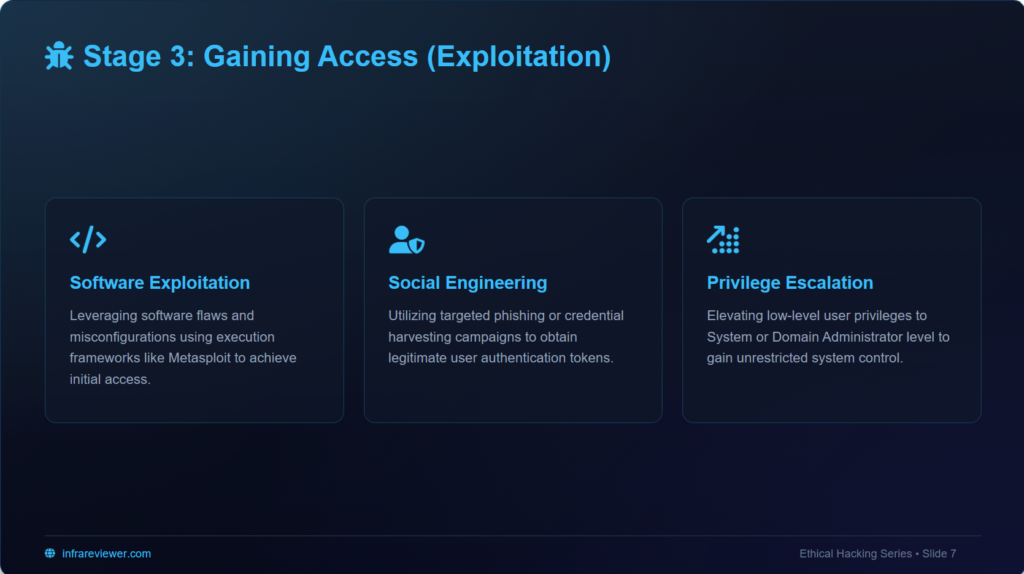
This is the core exploitation phase where discovered vulnerabilities are safely tested. Penetration testers attempt to breach target defenses, run proof-of-concept exploits, and escalate user privileges to demonstrate the real-world impact of a security flaw.
Stage 4 – Maintaining Access
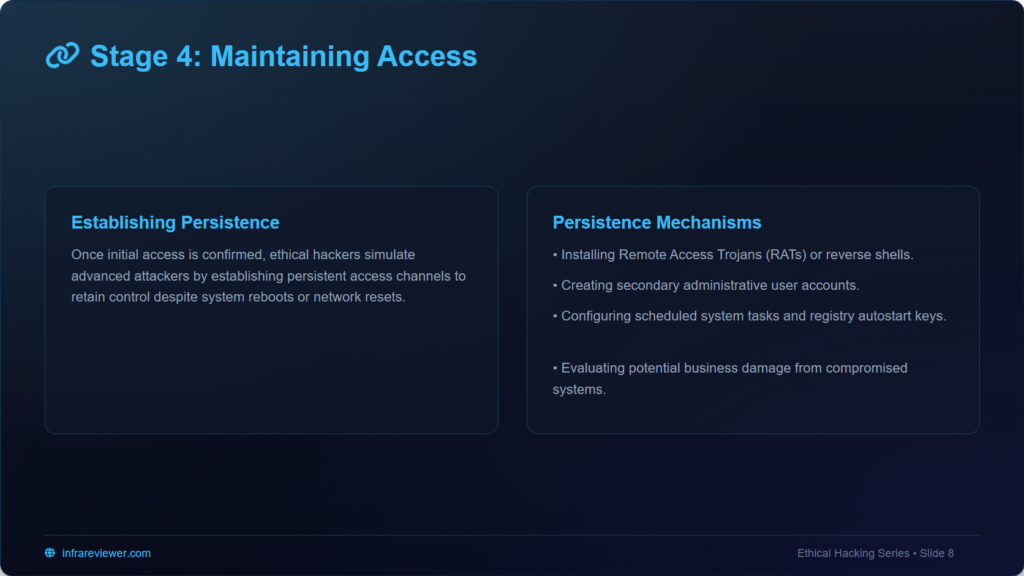
Once initial entry is gained, ethical hackers simulate how persistent attackers operate. This stage tests whether an attacker can establish backdoors or persistent connections to retain access over time without triggering detection from the organization’s Security Operations Center (SOC).
Stage 5 – Covering Tracks & Reporting
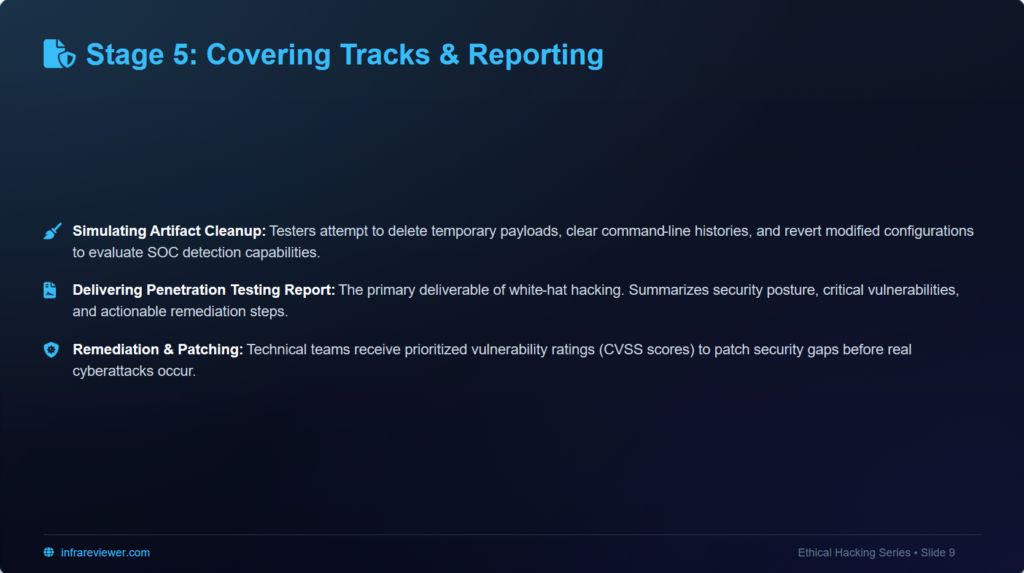
The final phase focuses on system remediation and formal reporting. After cleaning up uploaded test files and restoring configurations, security experts compile a comprehensive penetration testing report outlining vulnerabilities, risk ratings, and step-by-step remediation guidance.
Summary Comparison Table
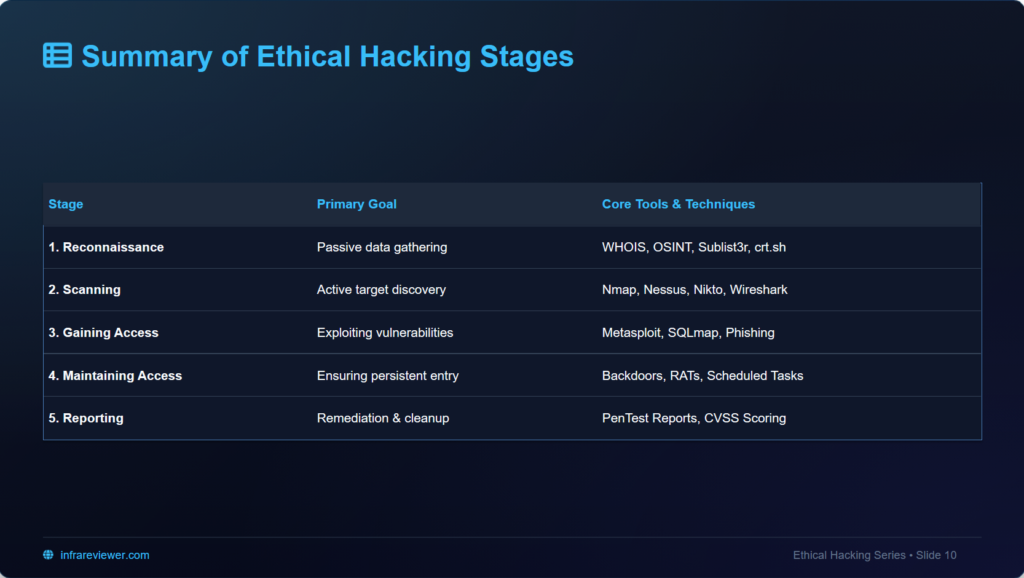
A quick-reference summary table comparing all 5 stages of ethical hacking, their core security objectives, and the primary technical tools utilized in each phase of a penetration test.
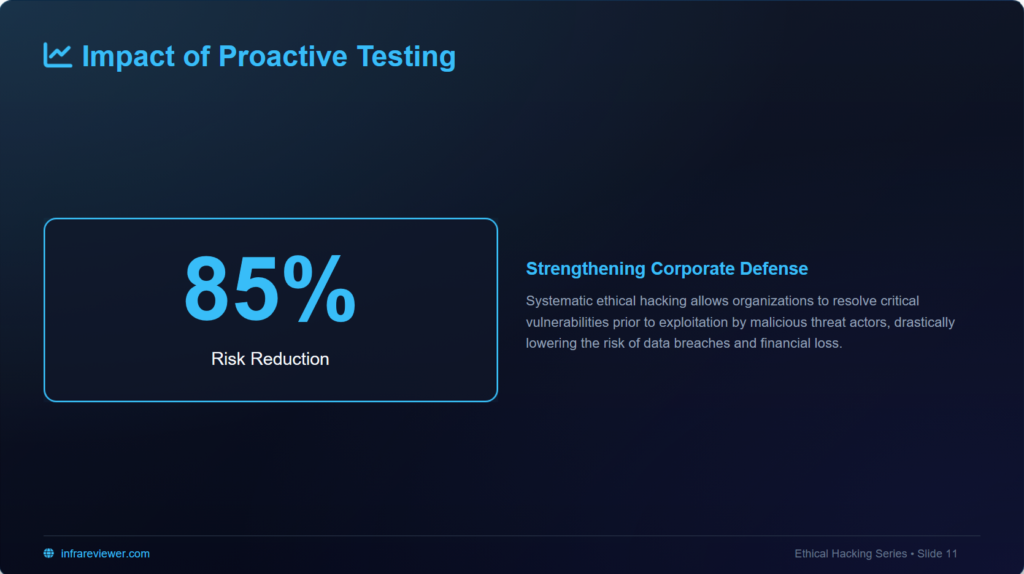
Systematic ethical hacking allows organizations to resolve critical vulnerabilities prior to exploitation by malicious threat actors, achieving an estimated 85% reduction in security risk while drastically lowering the threat of data breaches and financial loss